
Form Factor Assessment Model
The Form Factor Assessment is found on the Assess Page within the pre-race analysis section of TopRate.
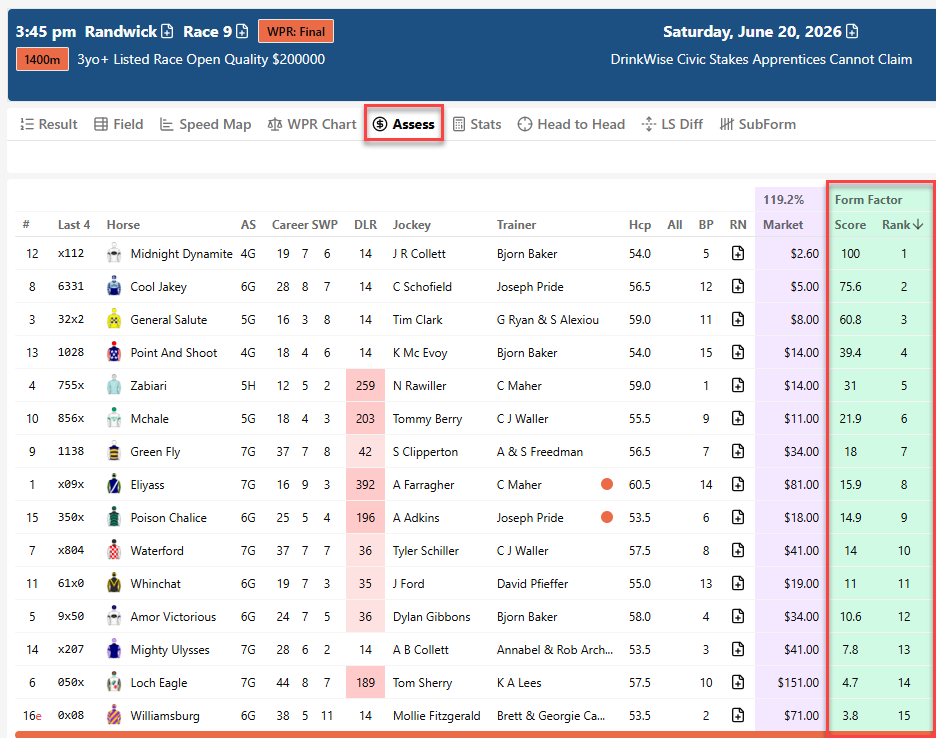
The model provides an independent assessment of each horse's overall profile strength, ranking runners from strongest to weakest based on a combination of ratings, form, trainers, jockeys and position in-running related factors.
Its purpose is not to tell you what to think, but to provide a powerful starting point for your race analysis and help identify the horses most worthy of further consideration.
What is the Form Factor Assessment?
The Form Factor Assessment is a machine learning model developed using a wide range of individual variables to identify the factors most strongly associated with winning.
The model evaluates each horse's profile and assigns:
- A Form Factor Rank (its ranking within the race)
- A Form Factor Score (the relative strength of its profile)
The model can assess races both at the nominations stage and after final fields have been declared.
Understanding the Form Factor Score
The highest-ranked horse in a race receives a score of 100. All other runners are then scaled relative to that horse.
For example:
| Horse | Score |
| Horse A | 100 |
| Horse B | 80 |
| Horse C | 65 |
| Horse D | 30 |
The scores are designed to represent relative profile strength.
- A horse with a score of 80 theoretically wins approximately 80 times for every 100 wins by the horse rated 100.
- A horse with a score of 30 would win approximately 30 times for every 100 wins by the top-rated runner.
⚠️ Don't get too caught up in the mathematics.
The real value of the model lies in understanding the rankings and general gap between runners, and how those differences fit with your own feel of the race and the market prices on offer. It's not important to focus too much on win rate differences between horses.
👉 Why Doesn't TopRate Convert Form Factor Scores Into Prices?
Many punters assume that an assessed price is the ultimate betting tool. In reality, accurately pricing horse races is one of the most difficult challenges in racing analysis.
Successful betting is rarely about blindly comparing two prices and backing anything that appears to be "overs".
Instead, it is about developing an understanding of:
- The objective strengths and weaknesses of each runner
- The subjective factors that influence the winning chance of each horse
- The level of uncertainty surrounding the key chances in a race
- What the market prices tell you about the structure of winning chances, and how that compares to your own assessment
- Whether the overall race scenario presents a betting opportunity that makes sense to you
For this reason, TopRate deliberately presents a Form Factor Score rather than an automatically generated assessed price.
Our aim is to encourage users to develop a deeper understanding of each race and use the Form Factor Assessment as one piece of intelligence within a broader decision-making process.
In our experience, this approach is far more valuable than encouraging simplistic betting shortcuts based solely on price comparisons.
What Information Does the Model Use?
The Form Factor Assessment incorporates a wide range of variables, including:
WFA Performance Ratings
A variety of weight-adjusted WFA Performance Rating measures from a horse's form history, including:
- Recency-weighted ratings
- Median ratings across multiple time windows
- Peak ratings across multiple time windows
- Market expectation measures derived from betting prices
Historical Form Merit
Independent of ratings, the model also considers:
- Finishing positions
- Margins
- Race quality
- Field sizes
- Percentage of opposition defeated
Connections
- Trainer performance
- Jockey performance
Expected Race Position
The model estimates likely in-run positioning using factors such as:
- Previous racing patterns
- Barrier draw
- Distance
- Field composition
Important Notes:
- The Form Factor model does not consider current betting market prices when assessing the relative strength of each horse's profile.
- First Starters are not assigned a Form Factor Score or Rank.
- Assessments performed before final fields are declared (e.g. at nominations & weights stages) use only the information available at that time. For example, jockeys may not yet be known, barrier draws have not occurred, and weight adjustments for ratings have not been applied until the race reaches the "weights" stage.)
- As that additional information becomes available, the assessment is finalised.
Using the Form Factor Assessment
💡 There is no magic formula.
There are no fixed rules that guarantee profitable betting. The goal is to use the intelligence available to develop a clear understanding of each race and identify opportunities that make sense to you. Every race presents its own challenges, assumptions, and uncertainties, which is why successful betting remains a race-by-race and horse-by-horse exercise.
A good process for study is to:
- Gain an overview of the Form Factor Ranking and Scores across a race.
- Focus on and compare the score gaps between key runners near the top of the rankings (top four chances).
- Consider whether those gaps make sense to you, especially when you overlay subjective factors on the model assessment (see below about adding value to the model.)
- Compare the view you form on the above points to what the market is telling you about the race.
- Determine whether there are any betting opportunities that make sense to you.
💰 A Foundation for Successful Betting
One of the biggest mistakes punters make is believing they need to find longer-priced horses to make a profit.
In reality, some of the most successful betting opportunities come from identifying well-fancied horses that appear to have a greater edge over their opposition than the market suggests.
That doesn't mean blindly backing every horse that is clearly top-ranked by the Form Factor model.
Rather, it means looking for situations where:
- The model favours a horse as the top-ranked chance
- Your own assessment supports that view
- The market appears to have its dangers priced too closely.
When those factors align, you have the foundation for a high-quality betting opportunity.
A Short-List of Horses to Focus on as Betting Prospects
Testing across large samples of races that were not used in model development suggests a useful starting point is:
✅ Horses ranked 1 to 4 AND
✅ Form Factor Score 65 or higher
This group has historically produced stronger results than average. That does not mean blindly backing every horse that qualifies, because that's not enough to make a profit.
However, the task of turning that group of horses that return a small loss of -3% to -4% into a profitable strategy is far easier than other runners that average -8% to -12% betting returns, and longer for horses outside the top four chances.
Adding Value to the Model
The Form Factor Model provides something humans struggle to achieve:
- Objectivity
- Consistency
- Speed
- Coverage across every race
Its strength is processing vast amounts of information quickly and consistently, applying the same assessment principles to every horse in every race.
Its weakness, like all models, is that it cannot fully account for every circumstance, nuance, or unique scenario that exists within a race.
This is where your own analysis can add significant value.
💡 In our experience, the most effective approach to racing and betting combines the strengths of both data-driven analysis and human judgement:
- The objectivity, consistency and proven results of a quality assessment model
- Your own race review skills and insights, which can identify opportunities and nuances beyond what the model can see
- Personal judgement about which betting opportunities make the most sense
The combination of these strengths is far more powerful than relying exclusively on either a model or subjective opinion alone.
❓Questions to Ask to Help Add Value to the Form Factor Model
1. Does the Horse's Recent Form Have More Merit Than the Ratings Suggest?
A rating tells us what a horse achieved. It doesn't always tell us how difficult it was to achieve.
Consider whether recent performances may deserve upgrading because the horse:
- Had to work harder than others early to find its position
- Was disadvantaged by the race shape
- Covered extra ground, such as racing wide without cover
- Was held up, blocked, or suffered interference at crucial stages
These are the types of factors that can result in a performance having more merit than the raw rating alone suggests. Be conservative in how optimistic you are about the extra merit in a run, and it's not even necessary to come up with an objective figure, but where the evidence is clear, it is certainly a relevant factor to take note of.
2. Were There Genuine Excuses?
Sometimes, recent ratings may underestimate a horse's true ability because circumstances prevented it from performing to its best.
Examples include:
- Unsuitable track conditions
- Wide barrier draws that saw the horse settle much further back than normal
- Racing over unsuitable distances
- Being poorly ridden
- Being caught on the wrong part of a biased track
- Interrupted preparations
A horse coming off a run with legitimate excuses may be capable of improving significantly next start.
3. How Do the Key Chances Map Against Each Other?
Race shape and likely position in running remain among the most important factors in racing.
While the Form Factor model considers expected in-running position, it is still worthwhile conducting your own assessment of the map.
As a general principle:
- Favour horses as betting prospects with the tactical speed to race in the front half of the field.
- Be cautious about backing any horse likely to settle in the back half of the field, especially if they will be behind their main dangers. This single principle can significantly improve betting results over time.
4. Is the Horse Likely to Be Better Suited This Time?
Look for reasons why a horse may be capable of improving on its recent performances.
Important considerations include:
- Distance
- Track conditions
- Expected pace
- Likely position in running. One particularly positive angle is identifying horses likely to settle further forward than at their previous start.
5. Does the Horse Have Upside?
The model can only assess what has already occurred. It cannot perfectly forecast future improvement.
Look for horses that may still be developing and/or have shown signs of upside potential, including:
- Lightly raced horses with an upward rating trend
- Horses that hit the line strongly last start, especially if unsuited by the speed. Ensure there is some merit in their sectionals, rather than just finishing moderately over the top of very tired horses.
- Horses that historically improve after gaining fitness from a first-up or second-up run.
6. Are There Positive or Negative Traits Not Captured by the Data?
Not all important factors are easily measured.
Examples include:
Acceleration vs One-Paced Profiles
Horses that can produce a turn of foot, either to make ground faster than their rivals and put themselves into a challenging position in the race, or create a decisive break on their chasers from a forward position, generally have more ways to win races and are better equipped to adapt to different race scenarios.
By contrast, one-paced horses, while they may not be beaten far at the finish, tend to run home with the pack. They may make some late ground, but often do so when the race is already over, without ever looking like a genuine winning threat.
As a general principle, horses that can demonstrate some level of acceleration, even if only modest, are more appealing than those that simply maintain their speed and gradually pass tiring runners late in the race.
Racing Manners
Horses that have a tendency to miss the start, race keenly, hang in or out, or display other negative traits carry more risk in terms of producing a winning performance. Horses that do everything right are more reliable.
7. Are There Relevant Gear Changes?
Gear changes can influence performance in ways that historical data cannot fully anticipate.
Consider whether changes such as blinkers, winkers, visors, tongue ties or different bits could positively influence a horse's performance in the upcoming race.
Final Thoughts
The Form Factor Assessment is designed to help you focus your attention on the horses most likely to matter. Its greatest value comes not from blindly following the rankings, but from combining them with your own race analysis.
The more skilled you become at identifying insights that the model cannot fully capture, the more powerful the combination becomes.
Used this way, the Form Factor Assessment becomes a highly effective tool for making betting decisions with greater clarity, confidence and consistency.